Introduction
Elastocaloric refrigeration is one of the most promising ways to produce cooling without relying on the classic vapor-compression cycle. Behind the technical name is a simple idea: some materials change temperature when they are stretched, compressed or released. If that effect is controlled in a repeatable cycle, it could one day cool refrigerators, heat pumps, air conditioners or compact electronic devices with solid materials instead of refrigerant gases.
The subject matters because cooling demand is rising worldwide. Domestic refrigerators, freezers, air conditioning, heat pumps, food cold chains and medical storage all need reliable cold. Most current systems still depend on refrigerant fluids and electricity-hungry compression systems. Modern refrigerants are cleaner than old CFCs and HCFCs, but leaks, climate impact and energy consumption remain important issues.
Elastocaloric cooling offers another path: a compact solid-state system, potentially efficient, with no refrigerant gas in the active cooling process. It is not ready to replace your kitchen refrigerator yet, but recent research shows that it deserves a serious place in the future of refrigeration.
What is elastocaloric refrigeration?
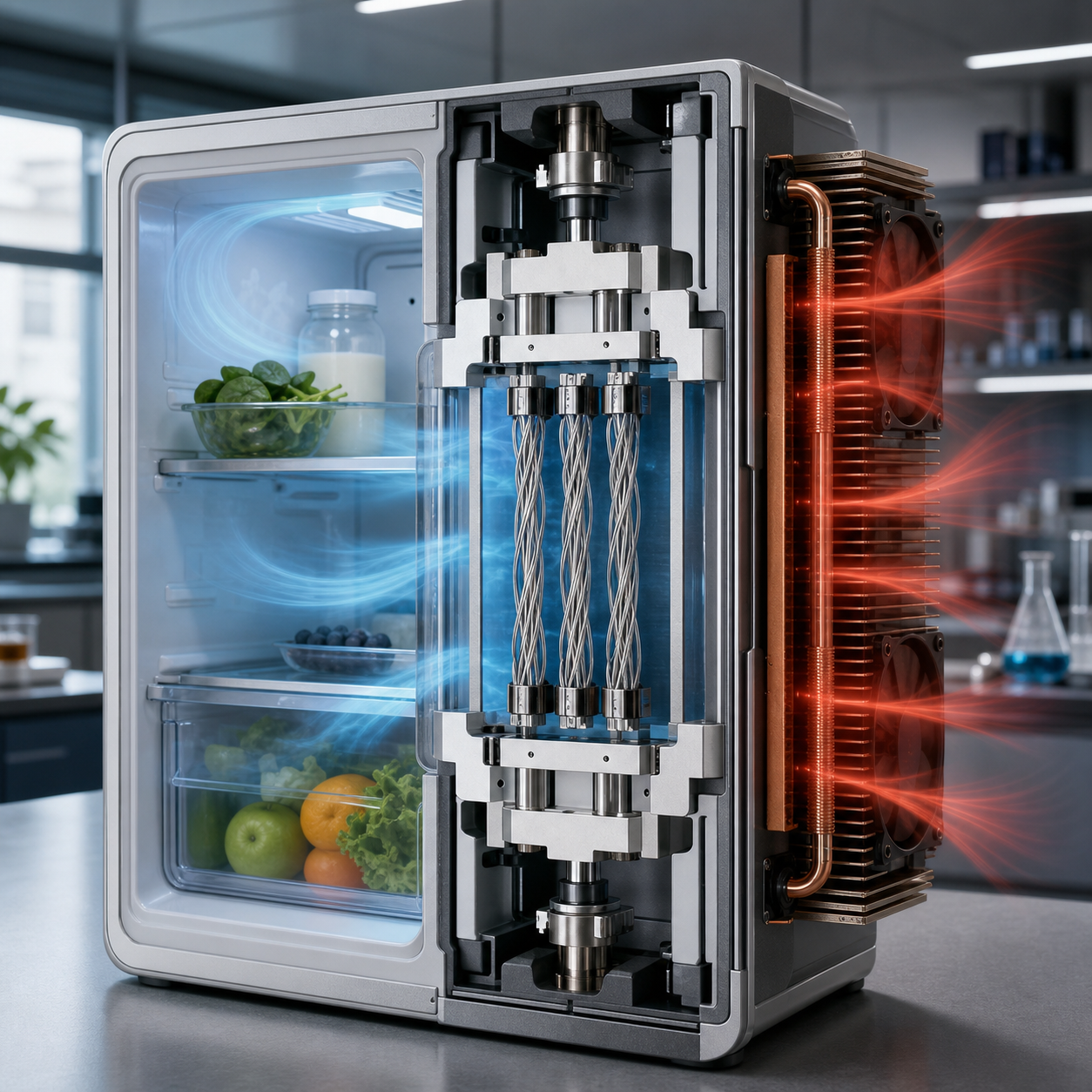
Elastocaloric refrigeration is a solid-state cooling technology. It uses the elastocaloric effect, which is the reversible temperature change of a material when a mechanical stress is applied or removed.
In practical terms, an elastocaloric material can heat up when it is stretched or compressed, then cool down when the stress is released. This behavior comes from internal changes in the material: phase transitions, crystal structure reorientation, entropy change or molecular chain reorganization, depending on the material family.
A complete cooling cycle is usually described in four steps:
- The material is mechanically stressed and warms up.
- The heat is rejected to the outside.
- The mechanical stress is released and the material cools down.
- The cold material absorbs heat from the space that needs cooling.
Repeated many times, this cycle transfers heat from a cold zone to a warmer environment, just like a conventional refrigerator, but through a different physical principle.
Why is it called solid-state cooling?
In a traditional refrigerator, cold is produced by a refrigerant fluid that is compressed, condensed, expanded and evaporated. This cycle is efficient and well understood, but it depends on a sealed circuit, a compressor and a suitable gas or fluid.
Elastocaloric refrigeration relies on a solid active material. The heat transfer comes from a transformation inside that material, not from the evaporation of a refrigerant. This is why it belongs to the wider family of solid-state cooling technologies, together with magnetocaloric, electrocaloric and thermoelectric cooling.
This distinction is important for environmental reasons. A well designed elastocaloric system could avoid HFCs, HFOs, propane, isobutane or other refrigerants in the active cooling stage. Heat exchangers, mechanical actuators and electricity would still be needed, but the core cooling effect would come from a solid material.
How does the elastocaloric effect work?
The elastocaloric effect is a thermodynamic response to deformation. When a material is stretched, compressed or bent, its internal structure can change. That structural change modifies its entropy, which can release or absorb heat.
Shape-memory alloys are among the best studied examples, especially nickel-titanium alloys, often called NiTi or nitinol. These materials can switch between crystal phases such as austenite and martensite. When mechanical stress triggers that transformation, latent heat is released or absorbed.
A simple version of the cycle looks like this:
- Under stress, the material changes phase and tends to warm up.
- That heat is removed toward the outside.
- When the stress is released, the material transforms back and cools down.
- The colder material can then absorb heat from the refrigerator compartment or another target zone.
The principle is sometimes compared with a rubber band that warms slightly when stretched and cools when released. Real elastocaloric cooling materials are engineered to make that effect stronger, more stable and more useful.
Which materials are being studied?
Elastocaloric materials are not a single category. Several families are being explored.
Nickel-titanium alloys
Nickel-titanium alloys are among the strongest candidates. They can produce a large elastocaloric effect, show good mechanical strength and can be tuned to operate near room temperature. Their main advantage is performance.
Their main difficulty is fatigue. A refrigerator must survive millions or even billions of cycles during its life. The material must therefore resist cracking, performance loss and thermal degradation over long periods.
Copper-based and iron-based alloys
Copper-based alloys such as Cu-Zn-Al or Cu-Al-Ni, as well as some iron-based alloys, are also studied. They may be cheaper than nickel-titanium, but their fatigue resistance, stability and useful temperature range must be carefully optimized.
The cost-performance balance is crucial. A material that works beautifully in the laboratory but is too expensive or too fragile will be hard to industrialize.
Polymers and elastomers
Elastocaloric polymers are another active research area. Stretching polymer chains can create useful temperature changes. These materials are light, flexible and potentially less expensive.
They also bring challenges: aging, hysteresis, heat transfer speed, mechanical strength and integration into an efficient exchanger. They are promising, but domestic appliances require years of reliable operation.
Why is this technology interesting?
Elastocaloric refrigeration addresses three major issues.
Less dependence on refrigerant fluids
Conventional refrigerators have improved a lot, but refrigerants are still a central environmental concern. Old CFCs and HCFCs were phased out because of ozone depletion. HFCs then raised climate concerns. HFOs and hydrocarbons such as isobutane or propane reduce part of the problem, but they do not eliminate the classic refrigeration circuit.
An elastocaloric system could produce cold without a refrigerant gas in the active stage. That could reduce leakage risks and simplify part of the environmental equation.
Better energy efficiency
Cooling is a major share of global electricity use. Any more efficient technology could reduce energy bills and emissions linked to power generation.
Recent prototypes show encouraging performance, but caution is needed. A laboratory result does not automatically become a consumer product. Real efficiency depends on the material, mechanical actuation, heat exchangers, cycle control and system losses.
Compact and quieter devices
An elastocaloric refrigerator might need fewer conventional components than a compressor-based appliance. It would not necessarily use a traditional compressor. That opens possibilities for quieter appliances, compact modules, medical cooling, electronics cooling, electric vehicles, mini heat pumps or localized air conditioning.
What still blocks a real elastocaloric refrigerator?
The technology is promising, but it is not yet mature for the mass market.
Material fatigue
Durability is the first obstacle. A material that performs well for a few thousand cycles is not enough. Domestic appliances must last for years, so the active material must tolerate repeated stretching, compression or bending without losing its properties.
This is especially important for shape-memory alloys, where repeated phase transformations can create internal stress and microscopic damage.
Mechanical force
Some materials require large forces to produce a strong temperature change. Applying large forces requires robust mechanics, consumes energy and can create noise or wear.
Researchers are therefore looking for materials that deliver a large effect with moderate stress, and for mechanical architectures that apply that stress efficiently.
Heat transfer
Cooling a material is only part of the challenge. A refrigerator also needs to move heat quickly from air, food or another load into that material, then reject it outside.
The final performance depends as much on thermal engineering as on the active material. Surface area, airflow or liquid circulation, cycle speed, insulation and electronic control all matter.
Industrial cost
To reach a kitchen, a technology must be reliable, repairable, affordable and compatible with mass production. Prototypes still need to pass manufacturing, safety, standards, maintenance, recycling and supply-chain tests.
How is it different from magnetocaloric or Peltier cooling?
Elastocaloric refrigeration is not the only alternative to vapor compression.
Magnetocaloric cooling uses materials that change temperature under a magnetic field. It has been widely studied, but systems may need strong magnets and specific materials.
Electrocaloric cooling uses an electric field applied to certain materials. It is interesting for miniaturized systems, but integration remains difficult.
Thermoelectric cooling, based on the Peltier effect, already exists in some coolers and mini fridges. It is compact and has no refrigerant fluid, but its efficiency is usually lower than vapor compression for typical household refrigerators. We explain that technology in our article on the Peltier module and cooling.
Elastocaloric cooling stands out because it can offer a strong temperature change without intense magnetic or electric fields. Its challenge is mechanical: the system must stress the material many times, reliably and efficiently.
Can you buy an elastocaloric refrigerator today?
Not yet. Elastocaloric refrigeration is still mainly a research and prototype technology. Universities and industrial teams have demonstrated increasingly capable systems, but consumers cannot currently buy a standard elastocaloric kitchen refrigerator.
Early commercial uses may appear first where the advantages are strongest: compact cooling, gas-free systems, electronics, medical devices, mobility, small heat pumps or localized air conditioning. A full-size household refrigerator will require more progress on durability, cost, safety and lifetime performance.
What could it change for household refrigerators?
If the technology matures, it could change several aspects of domestic refrigerators.
First, it could reduce climate impact related to refrigerant fluids. Current appliances already use cleaner gases such as isobutane, but a solid-state active system would avoid refrigerant leakage in the cooling core.
Second, it could improve energy efficiency if mechanical and thermal losses are controlled. A refrigerator runs day and night, so even moderate savings matter over a year.
Third, it could change appliance design. Cooling modules could become flatter, quieter and easier to integrate into furniture, drawers or targeted cold zones. The refrigerator might become less like a single large cabinet and more like a set of discreet thermal modules.
Should you wait before buying a fridge?
No. If you need to replace a refrigerator today, choose an efficient model that already exists, is correctly sized and uses a modern refrigerant. Elastocaloric cooling is a future technology, not a current buying option.
To reduce energy use now, focus on practical choices:
- choose a refrigerator with a good energy rating;
- match the volume to your real needs;
- set the fridge compartment around 4°C;
- avoid placing the appliance near a heat source;
- clean the rear grille or condenser if accessible;
- check the door seals.
Our guide to ecological and economical refrigerators is a better starting point for an immediate purchase decision.
FAQ
Does elastocaloric refrigeration use a gas?
The active cooling principle does not use a refrigerant gas. It relies on a solid material under mechanical stress. A complete machine may still use air, water or another secondary fluid to move heat, but that is not the same as a vapor-compression refrigerant circuit.
Is it really ecological?
The ecological potential is real because the active stage can avoid high-impact refrigerants and may be energy efficient. The final impact will depend on material production, lifetime, recycling and real-world system efficiency.
Is it the same as the Peltier effect?
No. Peltier cooling uses electric current in thermoelectric materials. Elastocaloric cooling uses mechanical stress in a material. Both are solid-state cooling technologies, but the physics and performance profiles are different.
Why is it not in stores yet?
Because prototypes still need better fatigue resistance, lower cost, reliable actuation, efficient heat exchangers, certification and industrial production.
Scientific references
- Suxin Qian et al., "A review of elastocaloric cooling: Materials, cycles and system integrations", International Journal of Refrigeration, 2016.
- Suxin Qian et al., "High-performance multimode elastocaloric cooling system", Science, 2023.
- Shixian Zhang et al., "Solid-state cooling by elastocaloric polymer with uniform chain-lengths", Nature Communications, 2022.
- CaloriCool resources on the elastocaloric effect and caloric materials.
Conclusion
Elastocaloric refrigeration could become one of the major alternatives to vapor-compression cooling. Its principle is elegant: use a solid material that heats or cools when mechanically stressed. Its promises are strong: fewer refrigerant-fluid concerns, potentially high efficiency and more compact devices.
The road to a household elastocaloric refrigerator is still demanding. Researchers must improve material lifetime, reduce mechanical stress, optimize heat exchangers and make the full system economically viable.
For consumers, the right approach is to follow the technology with interest while choosing efficient, repairable and well-sized refrigerators today. The future of cooling will depend not on one invention alone, but on better technologies, better habits and serious attention to energy use.