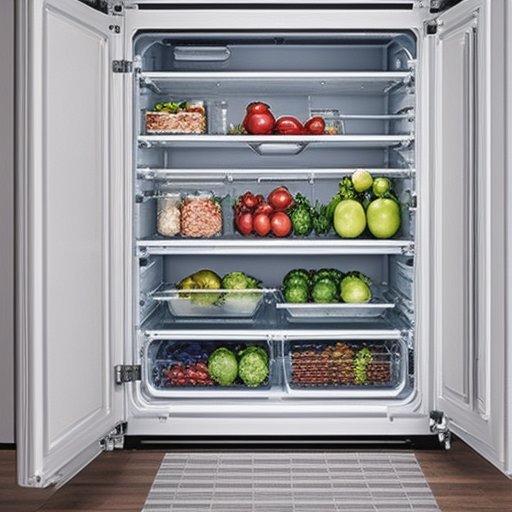
When you come home from a weekend or holiday, a refrigerator can look normal even if it lost power and restarted. That is the awkward part: the light turns on, the compressor may be running, but some food may have spent hours above a safe temperature.
To know whether your refrigerator turned off while you were away, combine three checks: the condition of frozen food, an actual temperature reading, and signs of water or unusual condensation. The FDA and FoodSafety.gov give useful food safety benchmarks: a closed refrigerator keeps food cold for about 4 hours, while a closed freezer keeps its temperature for about 48 hours when full, or 24 hours when half full.
Signs to check as soon as you get back
Look before you move food around or add new groceries. These clues will not always tell you the exact length of the outage, but they show whether you need to sort food more cautiously.
- Soft, misshapen or stuck-together frozen food: food that lost its shape and then froze again points to a temperature rise.
- Unusual ice crystals: irregular frost on packaging can mean partial thawing followed by refreezing.
- Water in the fridge or freezer: it may have another cause, but after an absence it is a warning sign.
- Spoilt smell from milk, meat, fish or cooked dishes: do not rely on smell alone, because unsafe food does not always smell bad.
- High temperature reading: if the refrigerator is above 5 °C or the freezer is warmer than -18 °C, you need to work out how long it may have been that way.
For everyday settings, the guide to the best refrigerator temperature gives more detailed benchmarks.
The coin in the freezer test
The best-known trick is useful if you prepare it before leaving:
- Fill a small container with water.
- Freeze it solid.
- Put a coin on top of the ice.
- When you return, check where the coin is.
If the coin is still on top, the freezer probably did not warm much. If it is in the middle or at the bottom of the container, the ice melted partly or fully before freezing again. That is strong evidence of a power cut or appliance failure.
The test does not prove that food is safe. It only shows that the freezer warmed up. To decide what to keep, inspect the food and measure temperature where possible.
The most reliable option: a thermometer
A thermometer in the refrigerator and another in the freezer are still the best tools. A simple model shows the temperature when you get home. A data logger or connected sensor is better because it shows whether the temperature crossed a risky threshold and for how long.
Before a longer absence, place the sensor in the centre of the compartment, not against the cold wall and not in the door. The door is usually the most unstable area. If you use a smart appliance or sensor, make sure temperature alerts are enabled and that the app works when you are away from your home Wi-Fi.
Which foods should be thrown away after an outage?
US food safety authorities recommend discarding perishable food that has been above 40 °F, about 4 °C, for 4 hours or more. In practice, if you do not know how long the refrigerator was warm, be careful with:
- meat, poultry, fish and seafood;
- milk, yoghurt, fresh cheeses and dairy desserts;
- eggs, opened sauces, leftovers and cooked dishes;
- ready-to-eat food that has already been chopped or cooked.
In the freezer, food that still contains ice crystals or has stayed at 4 °C or below can usually be cooked or refrozen under FDA guidance. By contrast, a fully thawed product that is warm, leaking or has swollen packaging should be discarded. The article on how long a refrigerator stays cold when it turns off explains the timing in more detail.
Check why the refrigerator stopped
Once the food is safe, look for the cause. Check the circuit breaker, socket, any extension lead or power strip, and the cable. Plug another appliance into the same socket to confirm it has power. If the refrigerator has restarted but cools poorly, listen for the compressor and monitor the temperature for several hours.
If the issue followed a power outage, the guide on a fridge that does not restart after a power cut covers the checks to make before calling a technician. Do not dismantle the refrigerant circuit or internal electrical components unless you are qualified.
Prevent the problem before you leave
Before being away for a few days, avoid filling the refrigerator with lots of very perishable food. Set the temperature correctly, close the doors firmly and keep the freezer reasonably full so it holds cold longer. Ice packs or frozen water bottles can help stabilise the temperature during a short outage.
For a long holiday, decide whether the appliance should stay plugged in or be emptied, cleaned and left with the door ajar. The choice depends mainly on the length of your absence and whether food remains inside. The guide on unplugging your fridge when going on holiday summarises the useful scenarios.
Frequently asked questions
Is the coin test reliable?
It is reliable for detecting partial melting in the freezer, not for guaranteeing that all food is safe. Use it alongside a thermometer and a cautious sort of sensitive food.
Can the refrigerator have turned off if the light works?
Yes. The light only proves that the appliance has power when you open the door. It does not prove that it ran continuously while you were away. A temporary outage, stuck thermostat or compressor fault can go unnoticed.
Can I keep food that still smells fine?
Not always. Appearance and smell are not enough to judge perishable food after a cold-chain break. If it may have been above 4 to 5 °C for too long, discard it.
What if everything refroze?
Do not assume refreezing makes food safe. Keep only products that still contain ice crystals or whose measured temperature stayed at 4 °C or below. For the rest, prioritise food safety.