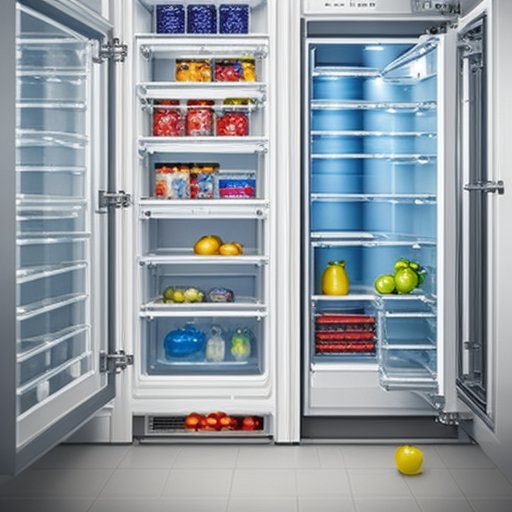
A fridge is rarely impossible to repair in a literal sense. The better question is whether it can be diagnosed, repaired properly and kept running for a sensible price. A door seal, thermostat or fan may be worth replacing. A hidden refrigerant leak, a failing compressor on an old unit or unavailable spare parts can make replacement the wiser choice.
Start with a separate appliance thermometer. The FDA recommends keeping the refrigerator at 40 °F or below, about 4 °C, and the freezer at 0 °F, about -18 °C. If the appliance cannot hold those temperatures after basic checks, it needs a serious diagnosis.
Warning signs that matter
The fridge still will not cool after simple checks
Check the power supply, circuit breaker, thermostat setting, door seal, frost build-up and condenser coils first. Our fridge breakdown checklist walks through the basic checks before calling a technician.
If the fridge stays above 4 or 5 °C for hours, the freezer cannot approach -18 °C, or temperatures swing unpredictably, the fault may involve the compressor, sealed cooling system, sensor or control board. That does not automatically mean "beyond repair", but it is no longer a quick adjustment.
The compressor runs almost constantly
A compressor that barely stops can point to a leaking door seal, dusty coils, a warm room or incorrect settings. Once those are ruled out, it can also suggest that the cooling system is losing efficiency.
This affects running costs as well as food safety. The Swiss Federal Office of Energy notes that the energy label shows measured consumption over 24 hours under standard test conditions, while real consumption depends on use and location. An old fridge running all day may cost more without cooling well.
A refrigerant leak is suspected
Oily marks near the compressor or pipework, a gradual loss of cooling and a compressor that keeps working hard can suggest a refrigerant leak. Do not pierce, recharge or open the cooling circuit yourself. Leak detection and refrigerant handling are jobs for a qualified technician.
On a recent, high-value appliance, repair may make sense if the leak is accessible and parts are available. On an old fridge, a leak buried in the insulation or sealed cabinet often makes repair uneconomic.
The compressor clicks, overheats or will not start
Repeated clicking, a short hum followed by silence, unusual heat or a total failure to start may come from the start relay, capacitor, control board or the compressor itself. Some of those parts can be reasonable to replace. A compressor replacement is a much larger job.
Ask for a written estimate. If the repair approaches half the price of a comparable new fridge, especially on an appliance more than ten years old, replacement often becomes the more practical decision.
Breakdowns keep returning
A worn gasket alone is not a death sentence. A single fan fault is not either. The pattern matters: unstable cooling, recurring frost, a noisy compressor, persistent odours, corrosion, bent hinges and intermittent electronics all appearing close together.
When several symptoms overlap, look at the total cost. Include the estimate, the risk of another call-out, possible food loss and electricity use. For local context, see our guide to fridge repair in Switzerland.
Spare parts are no longer available
Sometimes a fridge becomes beyond repair because the part cannot be sourced. This can happen with control boards, integrated handles, specific hinges, sensors and display modules. Search by the exact model reference, not just the brand name.
If the manufacturer, technician and parts suppliers cannot identify a compatible part, further repair attempts become guesswork.
Repair or replace: a practical decision table
| Situation | Likely decision |
|---|---|
| Recent fridge, clear fault, part available | Repair |
| Door seal, thermostat, fan or drawer fault | Usually repair |
| Older fridge with a high estimate | Compare with a new model |
| Hidden internal refrigerant leak | Replacement often makes sense |
| Failed compressor on a basic appliance | Replacement often makes sense |
| Several breakdowns in a few months | Strongly consider replacement |
| Rust, warped door, rare parts | Replace |
There is no universal cut-off. A large, built-in and expensive fridge may justify a bigger repair. A small, ageing and inefficient model rarely does.
Food safety: do not guess from smell alone
A fridge that no longer cools properly is also a food safety problem. The FDA advises using a thermometer because many fridge controls do not show the real internal temperature. If a long fault or outage has affected perishable food, be cautious rather than relying only on smell or appearance.
For power-related problems, our guide to a fridge not restarting after a power cut covers the next checks.
If the fridge really is at the end of its life
Do not dismantle the cooling circuit or dispose of the appliance casually. Older refrigerated appliances may contain refrigerants, oils and insulation materials that need proper handling. The EPA notes that refrigerated appliances should be disposed of in ways that prevent harmful emissions. In Switzerland, check retailer take-back, municipal services or your local recycling centre.
When replacing the fridge, compare capacity, annual energy use and noise, not just the purchase price. Energy labels are useful because they show consumption, fresh and frozen storage capacity and sound level.