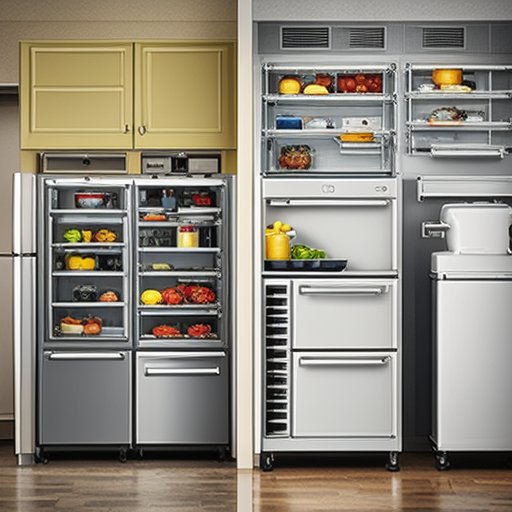
In less than a century, the refrigerator has gone from a noisy, expensive cabinet to a central, stylish and connected feature of the kitchen. This article traces the major stages of that transformation using concrete historical milestones, from the first machines of the 1910s to today's touchscreens.
The Utilitarian Beginnings (1910-1920)
The first domestic electric refrigerators appeared in the United States in the early 1910s. The DOMELRE (Domestic Electric Refrigerator), sold from 1913, is often cited as the first electric appliance designed for the home. By the end of the decade, brands such as Kelvinator and Frigidaire had launched their first self-contained models.
The real mass-market turning point came in 1927 with the General Electric Monitor Top. Its round compressor, mounted on top of the cabinet, earned it a nickname referencing the gun turret of the American Civil War ironclad USS Monitor. Priced at around 525 dollars at launch, it used sulphur dioxide as a refrigerant and became one of GE's best-selling products. At this stage the design remained above all functional: an enamelled box on tall legs, with little aesthetic ambition.
The Streamline and Art Deco Era (1930s)
In the 1930s, the refrigerator became a design object in its own right. In 1934, the retailer Sears hired industrial designer Raymond Loewy to overhaul its Coldspot model. The result, the Coldspot Super Six, made a strong impression: flowing lines inspired by the streamline movement, a single-piece body, an easy touch-a-bar door opener and rustproof aluminium shelving. Sears refreshed the model every year from 1935 to 1938, turning the appliance into a selling point as much as a storage tool.
This is the moment when the compressor disappeared under a smooth shell and aesthetics began to weigh as heavily as performance in the choice of a refrigerator. For the technical context of this period, see our article on the fascinating history of the refrigerator.
Colours and Social Status (1950s-1970s)
The post-war years made the refrigerator a symbol of modern comfort. The 1950s introduced pastel shades (turquoise, pink, pale yellow) that matched the optimism of the American kitchen. The trend peaked in the 1970s with two iconic colours: avocado green and harvest gold, found on most household appliances of the decade.
The refrigerator was no longer hidden away: it was shown off, coordinated with the rest of the kitchen. That logic of display foreshadows the still-current question of how to integrate a refrigerator harmoniously into a kitchen.
Stainless Steel and Large Formats (1990s-2000s)
From the 1990s, brushed stainless steel became the new standard, inspired by professional kitchens. It evoked cleanliness, durability and a certain premium feel. Formats evolved too: side-by-side models and then French door layouts, with two fridge doors on top and a freezer drawer below, became widespread, especially on large American-style refrigerators.
Design grew more restrained and discreet, with integrated handles, flat fronts and sometimes anti-fingerprint finishes to limit marks on the steel.
The Digital Era and Connected Fridges
The arrival of electronics turned the refrigerator into a smart appliance. The Samsung Family Hub, unveiled at CES 2016, captures this shift: a large touchscreen on the door, internal cameras that let you view the contents remotely, and shopping-management features. Screens, apps and sensors became commercial arguments in their own right.
These features are not always essential, and their real usefulness depends on personal habits. We discuss this in detail in our article on whether a smart fridge is really worth it.
Towards Eco-Responsible Design
Contemporary design now incorporates environmental constraints. The story of refrigerants is telling: the toxic gases of the early days (sulphur dioxide, ammonia) gave way to CFCs (Freon) in the 1930s, before these were banned under the 1987 Montreal Protocol because of their effect on the ozone layer. Today, most refrigerators sold in Europe use hydrocarbons such as isobutane (R600a), which are far less harmful to the climate.
Design follows the same logic: recyclable materials, better insulation, and above all energy classes prominently displayed on the European energy label, rescaled in 2021 onto an A to G scale. Low energy use has become as important a selling point as good looks. To go further, see our guide on the eco-friendly refrigerator.
Conclusion
The evolution of refrigerator design tells the story of a century of change: from the utilitarian box of the 1920s to the streamline curves of the 1930s, from the pop colours of the seventies to the stainless steel of the 2000s, right up to today's connected screens. Each generation blended aesthetics, technology and, increasingly, energy efficiency. The next chapter will likely be decided as much by environmental footprint as by style.
Sources
- Albany Institute of History and Art, GE Monitor Top Refrigerator
- Hagley Digital Archives, Coldspot refrigerator, Sears, Roebuck and Co.