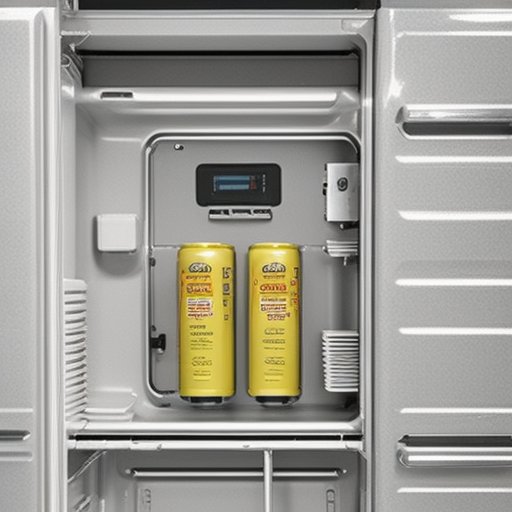
Yes, a refrigerator can technically be recharged with refrigerant, often called "gas". But in a domestic fridge, this is not routine maintenance and it is not a sensible DIY job. The cooling circuit is sealed. If refrigerant is missing, there is usually a leak or damage that must be found and repaired before any recharge.
So the useful question is not only "can you recharge a refrigerator with gas?", but "why is refrigerant missing, is the appliance worth repairing, and who is allowed to work on it?".
Short answer
In most cases:
- Do not recharge it yourself. Refrigerants can be flammable, climate-damaging or regulated.
- A recharge without leak repair is temporary. The refrigerant will escape again.
- Poor cooling is not always low gas. Thermostat faults, fans, door seals, dirty condenser coils and compressor issues can look similar.
- For an old fridge, replacement may be wiser. Compare repair cost, age, energy use and parts availability.
For the first checks, see why your refrigerator is not cooling and repairing a fridge that no longer cools.
Why a fridge should not "use up" its gas
Refrigerant circulates in a sealed loop through the compressor, condenser, expansion device and evaporator. It absorbs heat inside the fridge and releases it outside. It is not a consumable tank that runs down during normal use.
If the charge is low, likely causes include:
- a tiny leak at a joint or tube;
- a damaged evaporator or condenser;
- a previous poor repair;
- corrosion or cracking on an older appliance.
Adding refrigerant without finding the leak only hides the problem. It can also damage the compressor if the refrigerant type or quantity is wrong.
Symptoms that can look like low refrigerant
Low refrigerant can cause weak cooling, long compressor run times, unstable temperatures or frost in only one part of the evaporator. But those signs do not prove a leak.
Before blaming the refrigerant, check:
- the socket, breaker and thermostat setting;
- the real internal temperature with a thermometer;
- whether the condenser at the back or underneath is dusty;
- the door gasket condition;
- internal airflow;
- the fan, if your model has one;
- excess frost or a blocked defrost system.
If the appliance is still not cooling, it is time for a technician rather than a recharge kit.
Why DIY recharging is a bad idea
A domestic refrigerator is not usually built with an accessible recharge port like a car air-conditioning system. The circuit is often welded or brazed shut. A proper repair means identifying the exact refrigerant, recovering what remains, finding the leak, repairing it, vacuuming the circuit, weighing in the charge accurately and checking for leaks.
The risks are real:
- Fire, because many modern domestic fridges use R600a, which is flammable isobutane.
- Compressor damage from the wrong refrigerant, air in the circuit or overcharging.
- Pollution if refrigerant is released into the atmosphere.
- Warranty loss if an unauthorised person opens the sealed system.
- A worse leak if a valve or joint is fitted poorly.
Swiss and European rules
In Switzerland, the Federal Office for the Environment says refrigerants are regulated by Annex 2.10 of the Chemical Risk Reduction Ordinance to reduce emissions of ozone-depleting and high global-warming refrigerants: Refrigerants, FOEN. FOEN also states that professional or commercial manufacture, installation, maintenance or disposal of refrigeration appliances and the disposal of refrigerants require an appropriate specialist licence: Licence for the handling of refrigerants.
For old appliances, FOEN explains that refrigerators in Switzerland must be collected separately and processed so coolants are correctly handled: Refrigerators, FOEN. In the EU, the 2024 F-gas Regulation strengthens leak prevention, recovery and the phase-out of HFCs: European Commission, F-gas legislation.
The practical conclusion is simple: do not pierce, vent or recharge a fridge yourself.
When to call a professional
Call a qualified refrigeration technician if:
- the fridge cannot stay below 5 °C despite correct settings;
- the compressor runs almost continuously;
- the condenser is clean but cooling remains weak;
- you see oily residue near a tube or joint;
- the evaporator was punctured during defrosting;
- the appliance is recent or under warranty.
In Switzerland, compare the quote with the age, energy use and replacement cost of the appliance. The local options are covered in where to repair your fridge in Switzerland.
Repair or replace?
A recharge can make sense if the fridge is fairly recent, the leak is accessible, the repair is durable and the total cost is reasonable. It rarely makes sense on a very old, inefficient or corroded fridge.
A good diagnosis should answer four questions:
- Is the cooling fault really in the sealed refrigeration circuit?
- Can the leak be found and repaired?
- Is the correct refrigerant available and permitted?
- Is the repair cost lower than the realistic value of the appliance?
If several end-of-life symptoms appear, use the guide to signs a fridge is beyond repair.
Conclusion
You can recharge a refrigerator with gas only as part of a professional repair after leak diagnosis. For a homeowner, the right sequence is to check simple causes, measure the temperature, clean the condenser, then call a qualified technician if cooling remains poor. An improvised recharge is risky, often short-lived and may breach regulations. In many cases, the real decision is between a complete sealed-system repair and replacing the appliance.